Driving Miss Mercy
💀 With a little support, an old lady can still achieve her objectives
One thing you have to face when you are an octogenarian vigilante—you are going to make mistakes.
Things happen. The innocent girlfriend of an incel techbro will be found dead alongside him, the victim of a bad batch of cocatenyl; a pedophilic ex-president may end up in a coma instead of spattered at the bottom of a cliff.
And sometimes, the finely honed senses of a trained psychopath such as yourself will be dulled by painkillers, and you’ll miss your target by a country mile.
I placed the length of my bio-rifle into a well-scouted mine shaft, stashed my old-fashioned orienteering map and took my carbon fiber walking sticks firmly in either hand. The Cornish Coast Path ribboned ahead of me down to Watergate Bay, and by the time I made it to the car park, the hunt would be well and truly up for a sniper who got this close to capping the drug-smuggling former royal royal who’d made a fish-colored and flabby appearance on the south coast’s loveliest beach.
For that, if nothing else, the man deserved a quick end. I can never unsee that.
As I strode at a fast clip past the incoming hordes of police, influencers, and ill-paid journalists, I promised myself that he wouldn’t escape me next time. And that he would be fully dressed.
Because while I didn’t sweat a few mistakes, I knew my days were numbered. I’d never see another spring.
And I had a lot of work to do.
I drove the borrowed rental back to the region’s tiny airport. I’d called a car to pick me up at a time precisely five minutes after I ducked into the little Queen’s room at the Pelican’s Nest Pub. Reluctantly, I left my walking poles inside and met my driver, an Egyptian former soldier I’d picked on the driver app. He looked tired.
“Mrs. Mercy?” He didn’t know me, of course.
I smiled, letting him get a good look at my faded blonde hair escaped from its band and my cancer scarred nose. I took care to establish my presence, and a sharp observer like Ramsis Wadie would give me as good an alibi as a guilty woman could have.
I didn’t think I would need it, but it paid to be careful.
“Mr. Wadie? Yes, it’s me, Miss Mercy. Thanks for picking me up.”
He sighed visibly. “It’s my job.”
“Nevertheless.” I climbed into the front of his beater of a Land Rover. “I hope you don’t mind? I’m prone to travel sickness.”
Ramsis winced, but nodded manfully. “I have you down for a B&B at St. Ives. You know that’s a long ride? Outside my usual scope.”
“Oh, yes, but I’ve heard the light there is sublime, and I’ve brought my watercolors.” I patted the backpack that was my only luggage. “It’s so much easier than waiting for the bus. At my age, waiting of any kind is a risk.” I gave him my archest teeth, and he winced again.
Which disappointed me. Those teeth had cost a fortune after an accident in a Florida swamp involving an outboard motor and the ugly green tie of a prison developer.
“Mr. Wadie, have I done something to offend?”
He looked downright startled. “No, madam. I’m simply not used to being spoken to.”
“Oh. How do you usually spend your time, then, if not chatting with your fares?”
Silently, he tapped the tiny headset he wore in his ears.
“Oh, my goodness. Well, why don’t I let you get back to your music.” I smiled sorrowfully, the better to establish myself as a pitiful old relic, and turned toward the passenger window.
We were driving the A30 at a speed higher than I was used to. I never let myself drive over 50 unless I was on a job. Little old lady drives slow—no mystery there, and I was proof against a few middle fingers.
The sky was overcast, but a glorious double rainbow peeked out. I let myself oo and ah in a whisper to keep Mr. Wadie informed of my naiveté.
“Night school,” he said.
“Pardon me?”
“It’s not music, it’s night school. I’m trying to get my degree in philosophy—again. I hope to teach. Before the coup, I taught at the American University in Cairo.”
He meant the American coup, of course. With half the States up in arms, and the other half shooting at them, most Europeans (and apparently North Africans) accepted that the current regime was anything but democratically elected.
“I’m sorry,” I said automatically. I sometimes found it necessary to play an ugly American, too true in these times, but I didn’t unless I had to.
His eyes cut over to mine as he kept his hands on the wheel like we were driving in the Dakar, not on a highway in bucolic County Cornwall. “Why did you ask for me?”
“Ask for…?” Rats, I hadn’t expected that. “Simply because my mother spent some time in Egypt as a tr—teacher.” What is the matter with me? “Your name brought back some of her stories. It’s Coptic Christian, isn’t it?”
I knew it was rude to discuss religion, but I needed him distracted from my poor judgement.
He didn’t show offense. “Yes, my parents were. Are. Were. Actually, I haven’t seen them in a decade.”
“I’m sorry to hear that. Family is important.” When you had any, it was.
He shrugged. “Sometimes it is. Other times, you find yourself on the other side of a war from them, and they become less important.”
“It’s true. We can’t choose our relatives, but we can choose our friends.”
Another thing I was low on these days, which was just as well. I didn’t even keep a cat anymore, instead donating my social security to rescues where I could get my kitten fix without risking a feline life. I wish I didn’t have to retain my house, but I had to pretend to live somewhere. And the reverse mortgage on it would keep the tax man from looking too deeply into my finances when the time came.
Mr. Wadie noticed my silence and kindly allowed me to maintain it. I assumed he’d increased the volume on his philosophy course and let myself drowse in the wet sunshine of a Cornish April day.
Without an awareness of the passage of time, I suddenly heard my driver speak my name.
“Miss Mercy. Miss Mercy!”
Poor man. Afraid I’d kicked the bucket. “Are we here so soon? Thank you so much, Mr. Wadie. Your tip is on the app, that’s correct?” I’d learned from listening to other old people that verifying technology was an excellent way to underline your general senility.
“Yes, it is. That’s very generous.”
“Is it? I’m not wonderful at dollar to pound conversions.” I didn’t want to be remembered for an excessively large tip. It conveyed the wrong, and therefore suspicious, message.
I grabbed my backpack and hoisted it carefully over my shoulder, turning toward the sprawling, newish bed and breakfast I’d selected for its middling reputation and the number of tourist buses it catered to. I’d only be staying a night, and I’d be able to blend easily with the foreign holiday-makers and walkers.
I’d almost forgotten Mr. Wadie when I heard his voice right behind me. “Miss Mercy, you dropped this in the footwell.”
I can’t tell you what my expression looked like when I saw what he held. My eyes glued to it for an instant, and then I met his eyes.
It was a .338 Lapua Magnum round. He recognized it—I could see it in the predatory hollowing around his eyes.
“Thank you, Mr. Wadie. I must have brought that from home.” Where we hunt big game at a 3/4 mile distance.
I took the cylinder from his light grasp, smiled sunnily, and slipped it into my pocket.
The driver stared at me, and at that precise moment, the sound of a television set tuned to BBC 1 barked loudly.
“If you’re just joining us now, we’re live from the Cornish ‘porth’ at Watergate, close to the famous Newquay beach, reporting on what the local constabulary insist is not an attempted murder of the British Isles’ most infamous former royal. While access to the bay is temporarily closed, there’s no sign of Buckingham Palace’s own investigating—“
A tap on my shoulder broke my concentration. I swung around so fast I almost lost my balance.
“Greetings, madam! Are you with the Landsdown Tours bus?” An overly red man in his forties stood behind me, half-bowing in a way reminiscent of a British television comedian I probably never knew the name of. “If so, could you come this way and sign in for the tour?”
I shifted my gaze toward Mr. Wadie, but he had returned to his car. As he carefully turned out of the tight parking lot, he raised a hand in farewell.
I felt the tension leave my body. He knows, but he isn’t going to tell.
“Yes, I’m ahead of the group. I’ll be happy to sign us in, if you don’t mind me getting settled in my room. My feet are killing me!” I emphasized the word killing like a good American, and saw the proprietor flinch.
“That would be very helpful, Mrs.—?” He paused for me to fill in the blank, but I’d danced this dance enough to know the steps.
“I like to be helpful. If you knew the number of times that I’ve stood in for the tour guide! They aren’t very good, really, but you can’t blame them, they hardly get paid at all and some of the seniors on this tour are the worst talkers, and sometimes very sexist into the bargain. Old ladies not excepted! They just love to make a young woman feel she’d not worth a hill of beans, don’t they?”
By the time I’d found my way to the end of that piece of theater, the proprietor had turned and was leading me to the reception area. Behind me, I could hear a bus with squeaky air brakes making the final hairpin bend into the street, so I hurried my pace.
The proprietor held out the electronic sign-in on a tablet smeared with what I hoped was butter. “If you could just sign here, Mrs.?” Again, he tried to get my name. I signed the tablet with an illegible flourish and picked one of the single rooms. “I’m in room 12, I see. That’s wonderful! No view, but close to the shared lav. Lav is what you call a bathroom, they tell me.”
He took the tablet, checked off the name of the woman who’d ordered the single room, and handed me an old-fashioned key on a chain with seashells dangling from it.
Thank the stars and bars.
I needed a wash, a meal, and quite possibly a fast exit. I couldn’t ask Mr. Wadie to keep my secret under questioning, and I preferred not to spend my last few months in a jail cell.
By the time I’d taken a bath and a nap, blessing the vegan feather down duvet in my stolen room, time for the B&B’s fixed price tea had come and gone. Tea was the country word for dinner, I knew, and there would be no food again until breakfast, and that would be continental.
Me and my inoperable tumor needed to eat real food, so I slunk out past the Landsdown seniors and searched the village for a chippie. My fond memories of fried cod and chips made my mouth begin to water long before the smell of fried fish floated my way. I also considered finding a launderette. The change of clothes in my backpack was due for a cleaning.
When I located the source of the smell of ambrosial seafood, it wasn’t a chippie at all, but an outdoor restaurant served by food trucks—the chippie, a local bakery selling pasties, and a scones and clotted cream vendor in a truck shaped like a tea kettle.
The rain had stopped for an hour, and the light in the west was almost as strong as during the wet afternoon. The days would get longer and warmer here, but I wouldn’t see it again.
In a few minutes I was seated at a tiny table with a peek-a-boo view of the ocean, a plate of fish, chips, pasty, and a dish of clotted cream.
Live a little, I thought. I’d wrap up the remains and eat it for breakfast on the train.
I’d dipped into each of my treasures, staring into the sunglazed sea, when the table wobbled.
“Miss Mercy,” said a familiar voice.
I didn’t need to look up, but I did. “Mr. Wadie. You’ve found me.”
“Were you hiding?”
“No, not at all.” Though now I wished I had. But it never answered to rush when you thought you’d been compromised. Stay with the plan, I’d learned, even if you accelerated it.
Ramsis Wadie pulled a chair over and placed his meal—a double order of chips and a pint of stout—on the table. The chips smelled of malt vinegar, which I’d had to forgo. Pesky drugs.
Without a word, he tucked into his food, working through it steadily and appreciatively while I finished the clotted cream. (Just a spoon, thank you. Scones are nothing but hockey pucks.) I wrapped the rest into the blank newspaper that was still used to keep oil from seeping out.
By the time I had it stowed in my backpack, he was halfway through his stout. “Can I get you something to drink?”
“No, thank you.” I would be on the local bus in an hour—no sense in needing to pee every few minutes. My whole life had come down to hydration balance.
Mr. Wadie held his stout up so the dregs of the day’s sun lit it like a Florida swamp, golden brown and turgid. He gazed at it for a long time. “Epictetus said, the necessity of circumstances proves friends and detects enemies.”
“You’re a stoic, Mr. Wadie?”
“I’m a lover of philosophy. And a man fed up with the darkness that has been hiding in the world.”
Are we doing this? I’d never told anyone. I had moments when I worried for my soul, but I’d decided to take my chances. This was my choice, and the consequences—spiritual and otherwise—would be my own. “The world has always contained hidden darkness. The best we can do is brighten our little village,” I waved my arm at the charming town of St. Ives.
Mr. Wadie took another sip, wrinkled his nose. “I always get a stout, and it tastes sublime until the last third. Why is that?”
I looked askance at his pint glass, glinting in the late sun. “You mean, the taste gets worse?”
He chuckled and placed his glass between us, then met my eyes. I could barely see his, they were the color of the stout. “Since I left the army, Miss Mercy, I have been looking for that village to brighten. Philosophy would be my lamp. But the darkness has all but swamped my little light.”
I turned from those brown eyes, not wanting to see his pain. “I have forty years on you, Mr. Wadie. From my great old age, let me tell you that while the darkness doesn’t go away, it can be pushed back into the holes where it festers, at least for a while.”
He leaned forward, his hands on the table, his fingernails white in the fading light. “That’s what you’re doing. And I want to help.”
I smiled and rubbed my scar. The damn thing looked like hell and itched when I cried. “What I am or am not doing is—or doesn’t have to be—any of your business, Mr. Wadie. It isn’t heroic or good or even effective, if I’m honest. These darknesses would leave the world, and others take their place, in time.”
“When I got back to my flat, I did some research, questioned some old acquaintances.”
I didn’t speak, but I must have shown my emotions, because he said, “I didn’t give anyone enough to connect the dots. After all, they don’t know what I know. And who would suspect?”
I kept my face bland.
He laughed. “Exactly. You look like an elderly house cleaner.”
“I probably am.”
“Miss Mercy, how long have you been cleaning house?”
I was insane for having this conversation. I considered the advisability of breaking my tooth and ending it all, but I was enjoying the night, even if it was becoming chilly. “I had to establish my identity after I—retired—from my previous employment.”
He didn’t ask me. I liked that.
“What prompted you to start?”
“I would have begun in 2016, but it took time to build my infrastructure.”
“Is Nobelle Mercy your real name?”
“It’s not even one of them. Is Ramsis Wadie yours?”
He swallowed, the rolling of his Adam’s apple making me think of crushed windpipes, choking, and poison. I smiled, forcing the memories back into the dark.
“It has been. I’ve had others.”
The sun was long gone and the late evening light was fading. If I didn’t move quickly, I would miss the last bus to the train station. “I enjoyed our talk, Mr. Wadie.” I stood slowly, letting my aches and pains settle into their familiar configuration.
Like a man from a bygone era, he stood with me. “Where next, Miss Mercy?”
I tightened my lips. Not quite a smile. “Home, of course,” I lied.
But Mr. Wadie didn’t listen. “I mean, who next?”
St. Petersburg had been scheduled for months, coinciding with the long-planned trip of a well-known dictator. “No agenda for the next few months, Mr. Wadie.”
He tapped the table with one hand. The tap was rhythmic, meditative.
“Goodbye, Mr. Wadie,” I said and turned toward the steep, cobbled street. The bus shelter was close, but I had to pick up my pace to make it in time.
I had been walking more than a quarter of the way when I became aware of a solid presence behind and to my left. I was no longer capable of much in the way of flight, and certainly not of fight, so I paused until he was even with me.
“It’s a lovely night for a drive,” he said.
The objective was achieved with little drama. Miss Mercy joined the tour, and two days later, the death was announced in the media as a stroke.
Already, his opponents were taking over, and no funeral was planned. His body had been cremated within the day.
Just as well. A thorough autopsy might have raised suspicion.
A visit to the States followed, where I joined her for three small jobs that didn’t make national news, then back to North Africa and Israel. Reluctantly, I didn’t go to Egypt, and by the time I caught up with her in Crete, she had lost even more weight.
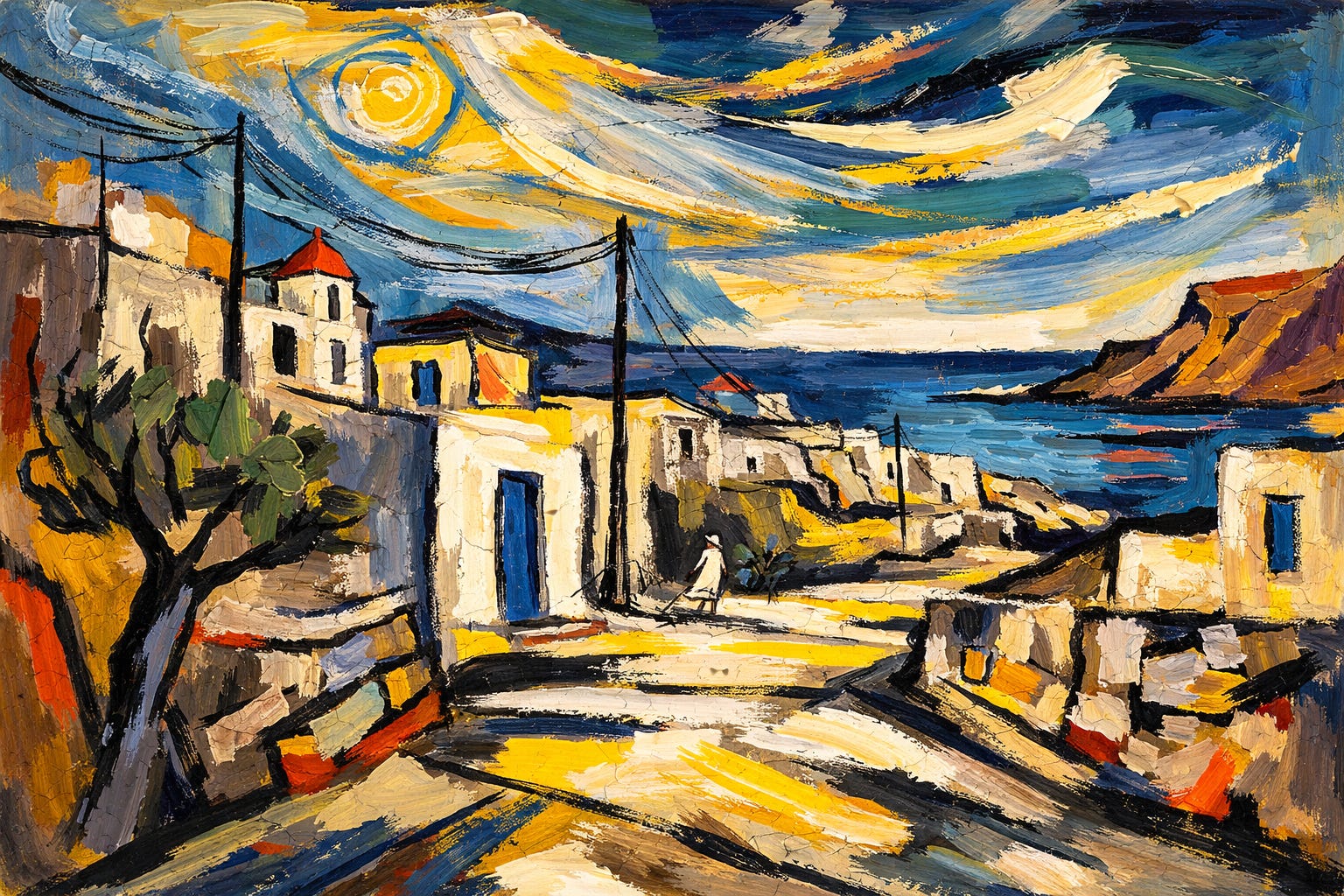
She sat in the bright summer sunshine in a cafe above the harbor, wearing a white cotton dress and wrapped in a bright Greek patterned blanket, her scarred face tilted up. I didn’t see her backpack.
“Kalispera, Mr. Wadie.”
“Kalispera, Miss Mercy.”
She sighed, and opened her eyes. “I love this island. I’ve never done a job here before. Just basked in the sun and the xenophilia.”
“Can I get you a Turkish coffee?” Traditionally, the only other coffee was Nescafe, but it had been many years since I visited. Perhaps there was a Starbucks on every corner.
“Efharisto, but I’ve had my dinner. I suppose it’s time.”
I frowned. She kept the timetable and the plan, I merely drove. But I had to object. “I think you could use some rest, Miss Mercy. Another few days in paradise, and then we forge on.”
She shook her head. “He’s here, Mr. Wadie. He isn’t important anymore, but even an old box of nitroglycerin can cause more damage. I missed in Cornwall, but this time, I can’t.”
I stayed silent, waiting for her to signal me to get the car. It was a rental, not in my own name.
She gazed along the street, smiling at passersby, who mumbled a surprised greeting to her when she offered a kalispera.
She laid a moleskine notebook on the table between us and covered it with her hand. “I’ve shifted my nestegg to a Swiss account, Mr. Wadie.”
The blood left my face. I did not want to benefit from an old woman’s gratitude.
But she knew what was on my mind. “My disposable income has already been given to various animal charities, Mr. Wadie. This money is for the work.”
My hand on the table jerked. I couldn’t help it. Did I want the money, or not?
“Oh, look at the time,” she said. More like a ghost than flesh and blood, she stood, shedding the blanket and patting it where it lay on the chair. “A woman in Anogia made that rug sixty years ago.”
A rising noise in the street drew my attention, and by the time I looked for her again, she’d disappeared into the crowd of old people walking in the afternoon.
I shifted to her chair and folded the blanket on my lap.
As the racket got louder, a group headed toward me from the harbor, sun glinting off glossy black hair and white caps. I put my hand over the notebook.
A taunting chorus made me raise my head in time to see it.
“It’s Randy Andy!” A group of girls and boys shouted and ran along the sides of the winding Rethymno street, giggling and rough-housing.
My eyes roamed over the oncoming cluster of dark-suited men. A dissolute face looked down at an elderly woman in a white dress holding out a piece of bread in the xenophilia tradition.
As he reached out to take the bread, the old woman suddenly threw her arm around his neck and bussed him aggressively on the mouth.
The swarm of henchmen closed in, but it was too late. He teetered like a broken toy, long enough that I saw the foam spilling from his mouth.
I stood. I couldn’t see her body through the horde of protectors, but I didn’t need to.
M.L. King might not approve of our choices, but I quote him anyway: The time is always right to do what is right.
I slipped the moleskine in my pocket.
Cornwall would be at its best in late summer, and I had a cover life to build.